Trine University Doctor of Physical Therapy (DPT) students and faculty presented research
at the American Physical Therapy Association’s largest national conference, the Combined
Sections Meeting, held in Anaheim, California, Feb. 12-14.
More than 15,000 attended the conference.
Student research
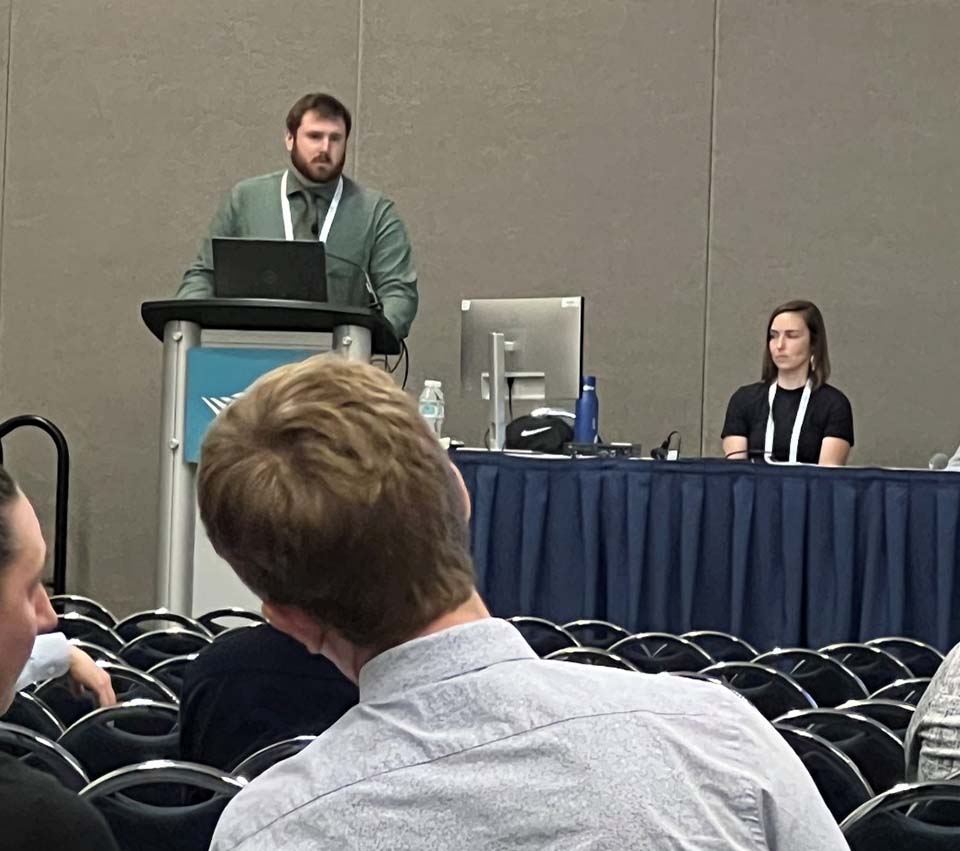
Charles Dunavan, a third-year DPT student from Clarkston, Michigan, presented a study
examining how Major League Baseball (MLB) pitchers perform after undergoing ulnar
collateral ligament reconstruction, more commonly known as “Tommy John” surgery.
Dunavan analyzed performance data from 59 MLB starting and relief pitchers before
and after surgery. He found that starting pitchers tended to show slight declines
in certain performance measures following surgery while relief pitchers often maintained
or even improved their performance.
These findings may help coaches, medical professionals and organizations better understand
how players recover and return to competition following major elbow surgery.
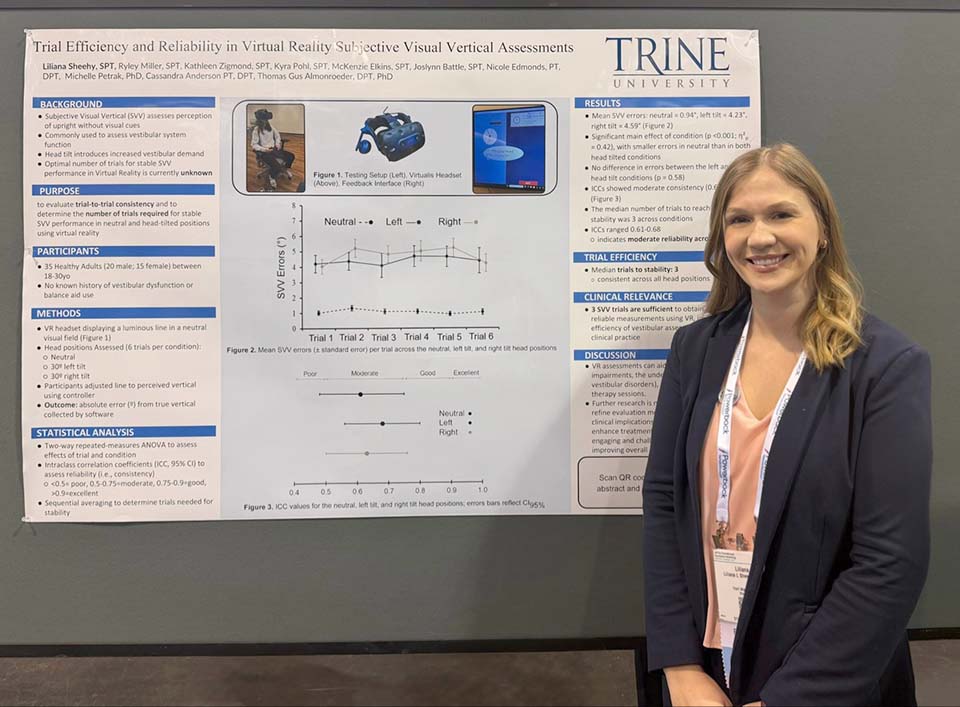
Lily Sheehy, a third-year DPT student originally from northwest Indiana, presented
a study exploring how virtual reality technology can be used to assess balance and
inner ear function.
Sheehy used a virtual reality headset system to test how accurately individuals could
align a line to “true vertical” when their head was in neutral and tilted positions.
She found that people made larger errors when their heads were tilted, which is expected
because the inner ear plays a key role in sensing upright position.
Importantly, the team found only three trials were needed to obtain consistent results,
making the test both efficient and reliable. These findings support the growing use
of virtual reality tools in clinical settings to assess dizziness, balance disorders
and inner ear function.
Faculty research
Trine DPT faculty Nicole Edmonds and Gus Almonroeder contributed to a collaborative
research study examining how student physical therapists experience a sense of belonging,
particularly within hybrid educational environments.
For their study, students from a hybrid DPT program completed a Sense of Belonging
Survey and participated in one-on-one qualitative interviews. Survey results showed
strong overall belonging scores.
However, interviews revealed important differences in how hybrid students experience
connection compared to traditional residential students. Students described specific
faculty behaviors, peer interactions and small “micro-affirmations” that strengthened
their sense of belonging. They also identified barriers unique to hybrid learning
environments, including life demands and the challenges of building relationships
in partially remote formats.
Almonroeder and Trine DPT faculty member Tricia Widenhoefer examined discharge recommendations
made by a national sample of acute care physical therapists when presented with clinical
vignettes describing hospitalized patients.
Previous research showed physical therapists play a key role in discharge planning
and that patient outcomes are better when physical therapists’ discharge recommendations
are followed.
Their first study looked at the consistency of discharge recommendations made by acute
care physical therapists. Results showed inconsistencies in the recommendations made,
and that therapist training and years of experience did not influence consistency.
Their second study found that physical therapists consider multiple factors such as
patient functioning, the therapist’s experience, and patient’s life context (home
setup, help at home, etc.) when making discharge recommendations. Their work highlights
the complexity of discharge decision making and the need to continuously look at ways
to improve the process.