New Trine University programs offer quicker pathway to careers
October 14, 2026
Students who want to become pharmacists or construction managers will soon have a quicker, more cost-efficient pathway to those careers.
1/3
March 18, 2026
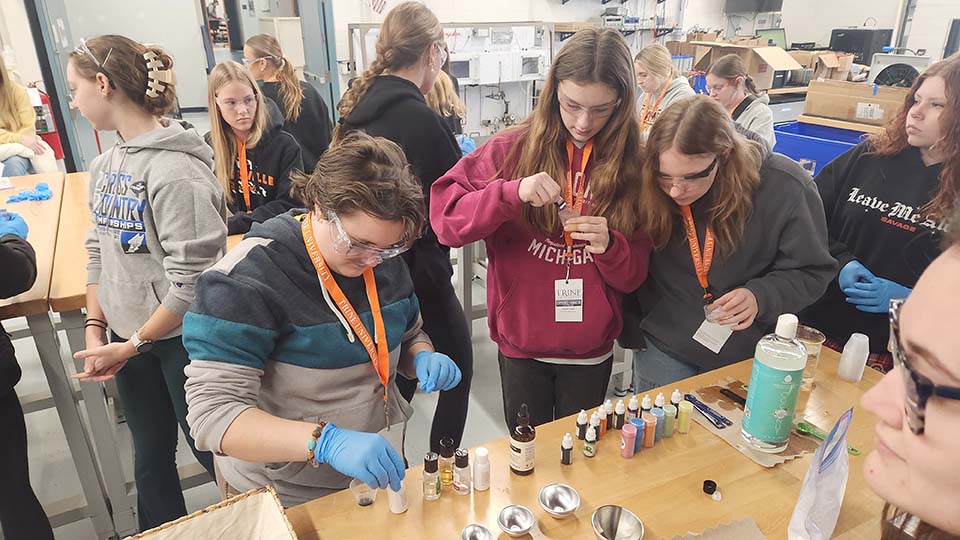
Trine University welcomed 124 high school students and ten educators from across Indiana, Michigan and Ohio on Feb. 24 for its annual "Impact Your Future" outreach day.
The event, which expanded this year from six to eight student session options, provided a comprehensive look at the modern Science, Technology, Engineering and Mathematics (STEM) landscape. Through high-tech laboratory experiences and a dedicated professional development track for teachers, the program aimed to bridge the gap between high school interest and collegiate-level innovation.
Kyle Jane, a chemistry teacher from Concordia Lutheran, attended for the first time this year.
“It was a well-orchestrated event that fit perfectly into a single school day,” he said. “I enjoyed the opportunity for students to select areas of their interest and they enjoyed getting to do hands-on activities.”
The student experience: From microfluidics to virtual cadavers
This year’s expanded curriculum, hosted by the McKetta Department of Chemical and Bioprocess Engineering with support from the Allen School of Engineering and Computing and the Rinker-Ross School of Health Sciences, allowed students to customize their day across four distinct scientific pillars.
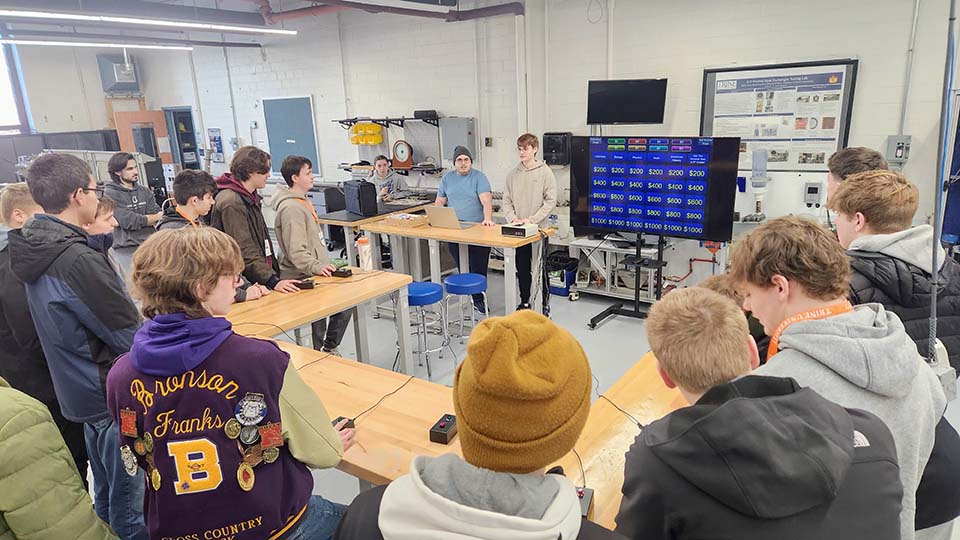
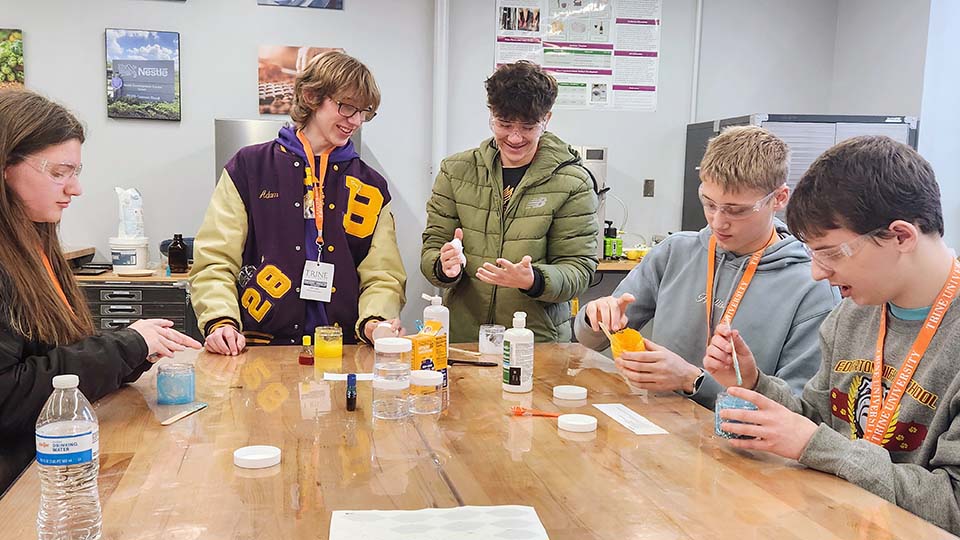
Within the chemical engineering sessions, students explored the versatility of polymers, learned the chemical reactions behind Trine University’s nationally competitive ChemE car and competed in their own STEM-themed Jeopardy. Activities also included extracting DNA from strawberries and learning the process and scale-up of essential oil extraction.
"I learned that essential oils are so expensive because they have to use tons of water to only get a little sliver of oil," noted a student in their follow-up survey.
Participants engaged in hands-on activities that introduced key concepts and career opportunities in the field of biomedical engineering. Students constructed 3D-printed kinetic fingers and battery-powered eyeball models to explore biomedical device design. They also explored lab-on-a-chip microfluidics and used virtual reality (VR) in the biomechanics lab to examine how engineers study human movement and develop medical technologies.
Participant feedback reflected both the challenge and breadth of the biomedical field. One student remarked, “I learned that fingers are hard to make,” while others discussed learning about exoskeletons and their various applications. Another participant concluded that “biomedical engineering is very broad.”
The chemistry, biochemistry, and forensic science tracks focused on the "science of the small," from isolating green fluorescent proteins to solving a "Forensic Whodunnit" using chemical clues. Students utilized advanced microscopes to visualize matter on a nanoscale.
"You can actually see atoms. I thought that we couldn’t see them because they were too small, but we used a needle on a microscope to see the waves," commented one student.
As part of the biology and environmental science activities, students engaged with the high-tech Anatomage table for virtual cadaver dissection and cell staining. The environmental track brought science to life through a photosynthesis experiment and the construction of active terrariums with live plants and insects.
"I absolutely loved the environmental science class and getting to make the mini terrarium... I learned how to keep cells alive and dye them to see under a microscope," concluded one student.
The teacher experience: Adapting STEM classrooms to an AI-powered world
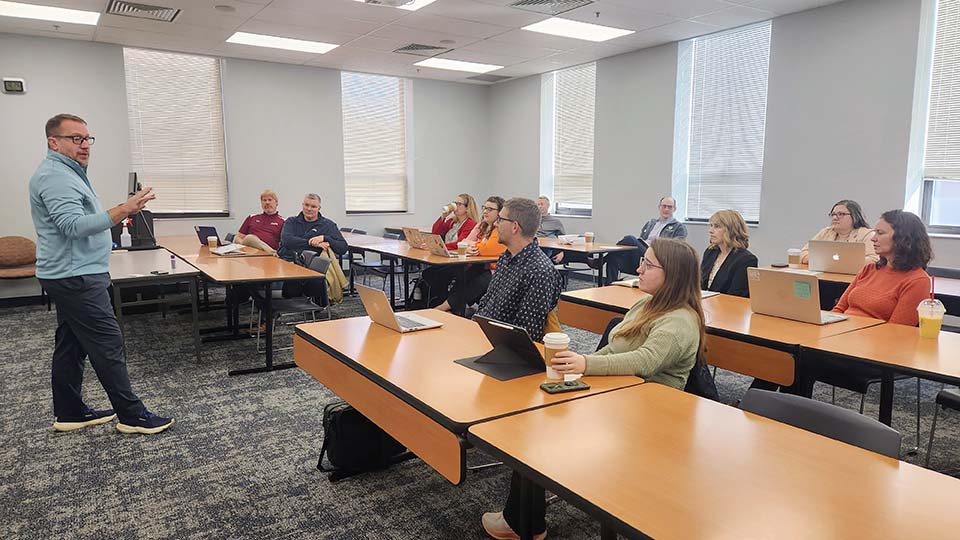
While students were in the labs, educators from eight regional schools joined Jeremy Rentz, Ph.D., professor in the Reiners Department of Civil and Environmental Engineering, for an organic discussion on the evolution of artificial intelligence in education.
The group discussed an analogy: "AI is a forklift—it can lift heavy objects. But learning is going to the weight room for years so that you can eventually lift those objects."
The session moved away from the concept of "AI-proof" assignments toward "AI-resistant" pedagogy. Key takeaways included:
"The AI discussion was great and will still be needed next year with how fast it is changing," noted Tracy Rendleman, a biology, anatomy and microbiology teacher from Edgerton High School.
Impact and future outlook
“Impact Your Future is a great event not only for our local teachers and their students, but for Trine University's faculty as well. This event facilitates connections between educators and allows us to all work together to improve STEM education in the region,” noted Samuel Drerup, Ph.D., and dean of the Rinker-Ross School of Health Sciences.
The 2026 "Impact Your Future" event proved to be a significant driver for regional STEM interest. Post-event surveys revealed that 68% of attending students plan to pursue a career in science or engineering. Furthermore, 39% of participants indicated they intend to visit Trine University again as they begin their college decision-making process.
For the visiting educators, the day provided a rare opportunity to align their high school curricula with the expectations of higher education.
"I enjoyed the discussion on AI and hearing other educators' perspectives," said Kim Miller, a chemistry teacher from Quincy High School in Michigan.
"I think this is an awesome program and I love the opportunity to bring my students. They thought being able to experience and see other avenues of engineering was impactful,” concluded Miller.
As Trine University continues to develop AI Literacy Outcomes across all its degree programs, events like "Impact Your Future" ensure that the next generation of engineers and scientists are prepared for the technological reality awaiting them.
Students who want to become pharmacists or construction managers will soon have a quicker, more cost-efficient pathway to those careers.
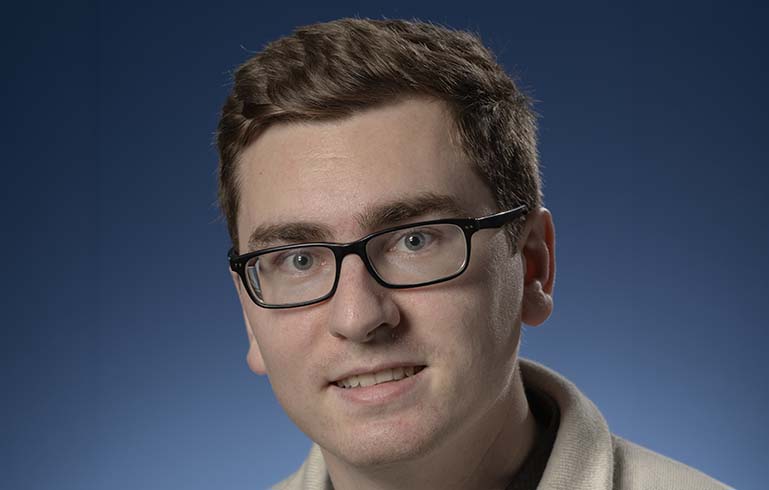
Jeremy Goossens, director of esports and industry innovation at Trine University, was named Director of the Season by ECAC Esports, the comprehensive collegiate esports league where Trine competes, for spring 2026.
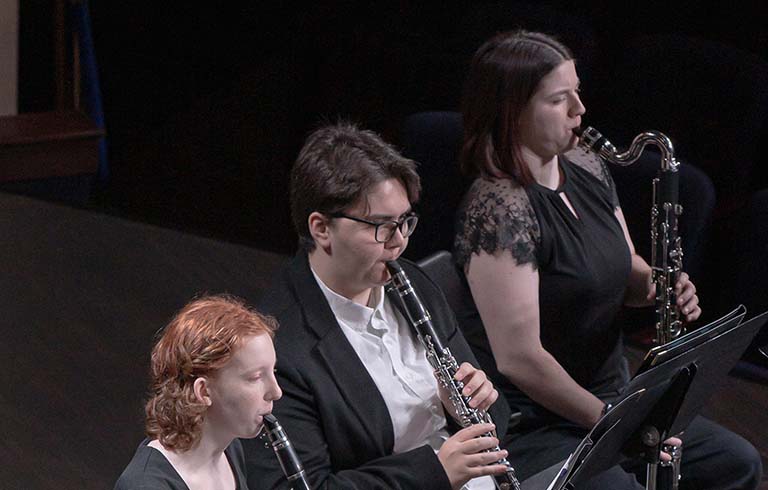
The Trine University music program will open its 2026-2027 concert season with the return of its annual “Halloween Haunt-cert” at 3 p.m. Saturday, Oct. 24.