$70K grant to fund undergraduate research at Trine
March 11, 2026
Share
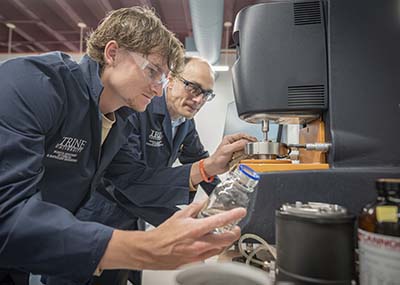
Trine University student Jacob Bilby, left, and Matthew Liberatore, Ph.D., chair of
the McKetta Department of Chemical and Bioprocess Engineering, conduct research in
the university's Fawick Hall. Liberatore has received a $70,000 grant from the American
Chemical Society (ACS) to support research into gels that could improve oil recovery
as well as impact production of food, cosmetics and pharmaceuticals. (Photo by Dean
Orewiler)
A Trine University faculty member has received a $70,000 grant from the American Chemical
Society (ACS) to support research into gels that could improve oil recovery as well
as impact production of food, cosmetics and pharmaceuticals.
Matthew Liberatore, Ph.D., chair of the McKetta Department of Chemical and Bioprocess
Engineering, received the grant from the ACS’s Petroleum Research Fund for Undergraduate
Research for his research, “Finding synergy between entanglements and crosslinks in
aqueous polyelectrolyte gels.”
Liberatore said the research seeks to design improved gels that can be used to make
underground oil recovery more effective and efficient.
The grant will cover materials and supplies for preparing and testing gels as well
as stipends for Liberatore and the Trine students who will assist with the research.
It also will cover travel for students to present their findings at regional and national
conferences.
Student involvement
Jacob Bilby, a chemical engineering major from Albany, Indiana, is initiating the
project. Additional students will join during the project’s three-year run.
Liberatore said the students will help prepare materials, run experiments and analyze
data.
“The students will gain experience using industry tools such as a rheometer and skills
that come with independent, lab-based projects,” Liberatore said. “Undergraduate research
experiences are essential for motivating students to pursue challenging science and
engineering problems.”
Liberatore said the faculty of the McKetta Department of Chemical and Bioprocess Engineering
mentor about 20% of chemical engineering students in research projects, a high number
since Trine is primarily an undergraduate institution.
‘Fishing net’
In oil recovery, Liberatore said, gels are used to control how fluids move underground,
displace oil from rocky domains and help produce more oil.
He said gels for oil recovery are typically created using polymer chains and added
salts that help the molecules hold together “like a molecular fishing net.”
However, large amounts of those ingredients are usually needed to make the gels strong
enough for the intended applications.
“Our idea is that the long polymer chains naturally tangle with each other, like cooked
spaghetti,” he explained. “These tangles might act like additional links in the molecular
netting. Thus, we hope our new gels will be mostly water with very small amounts of
other chemicals.”
Liberatore and the students will create new gels and study their strength under simulated
oil recovery conditions. He said they hope to find high-performing gels that cost
less, are easier to make and have less environmental impact than those currently used,
while still strong enough to handle the flow conditions in the field.
He said food, cosmetics and pharmaceuticals also use water-based gels in their products,
so the research could apply to those industries as well.
Petroleum Research Fund
Liberatore came to Trine with almost 20 years of experience at research universities,
including projects funded by the Petroleum Research Fund.
According to the ACS, the goals of the Petroleum Research Fund are to support fundamental
research in the petroleum field and to develop the next generation of engineers and
scientists through support of advanced scientific education.
Students from Trine University’s TAO chapter of the American Criminal Justice Association (ACJA) took top awards at the organization’s national conference, held March 8-13 in Bloomington, Minnesota.
Eight students from Trine University’s Reiners Department of Civil and Environmental Engineering recently attended the 112th Purdue Road School Transportation Conference and Expo.
Trine University will host its annual Take Back the Night rally and march to inform and educate the community about sexual assault, with the ultimate goal of prevention.