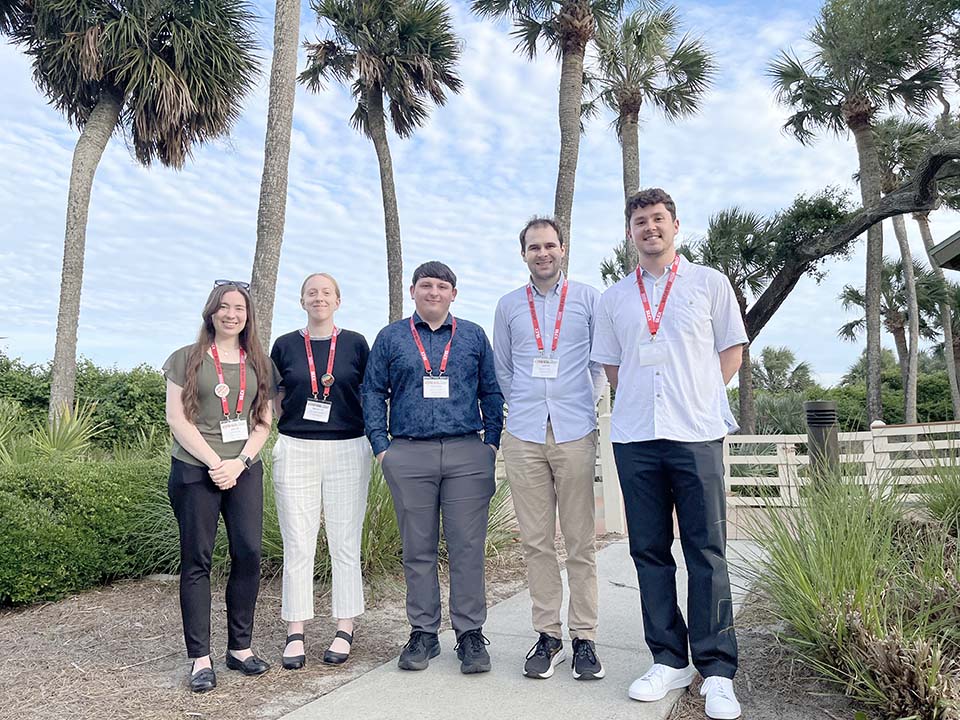
Four Trine University mechanical engineering students presented their original research
at an international conference focusing on microelectromechanical systems (MEMS) and
microsystems technologies.
The Solid-State Sensors, Actuators, and Microsystems Workshop, held every two years,
took place May 31 through June 4 in Hilton Head, South Carolina.
The Trine students work with James Miller, Ph.D., assistant professor in the Wade
Department of Mechanical and Aerospace Engineering, to research ways to make MEMS
resonators, which vibrate to allow devices to keep time and sense movement, work better.
The team is seeking to develop techniques to make the resonance frequencies of MEMS
resonators more stable by utilizing controlled mechanical tension, nonlinear operation
and amplifier circuit design to improve their performance.
They are investigating whether tuning the tension on the resonators — similar to tightening
a guitar string to tune it — will make the resonators’ frequencies more stable. This
work has applications for improved timekeeping devices, which are ubiquitous in modern
technology such as smartphones, computers and data centers.
The research is funded by a grant from the National Science Foundation.
Controlling noise sources
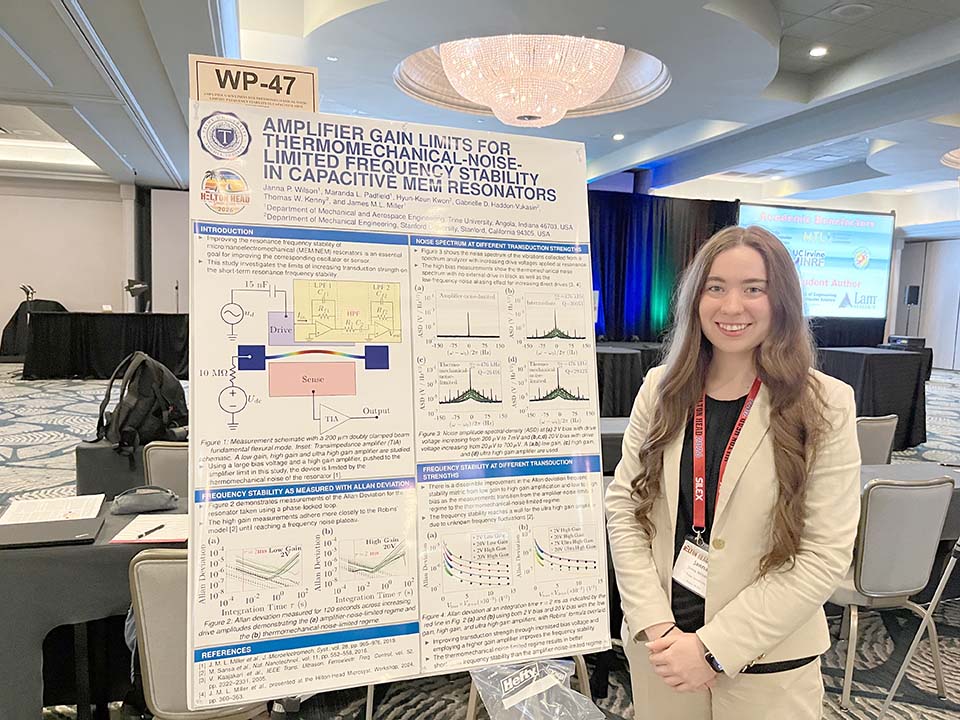
Janna Wilson of Kokomo, Indiana, presented on "Amplifier gain limits for thermomechanical-noise-limited
frequency stability in capacitive MEM resonators."
“I studied two different conditions a MEMS device can operate under,” she said. “In
one, the circuit surrounding the device produces the noise limitations when a low
bias voltage and low gain amplifier are used. In the other, the noise from the device’s
own thermomechanical motion is the limiting factor when a high gain amplifier and
high bias voltage are applied.”
She found that using high gain amplification and high biasing voltage to limit a device
to its own thermomechanical noise resulted in improved frequency stability and better
transduction (converting energy from one form to another) strength.
“These results are useful, seeing as most commercial MEMS devices are limited by noise
from the amplifier and therefore have room for improvement,” she said.
She said it was “highly encouraging” to have her research accepted for the workshop
and that she gained valuable experience as she looks ahead to applying to graduate
school and conducting more research.
“The conversations I had at my presentation were the most rewarding part of the conference,”
she said. “So many people wanted to hear more about the work our lab is doing, and
it was great to hear so many new perspectives on my topic.”
More strain, more stability
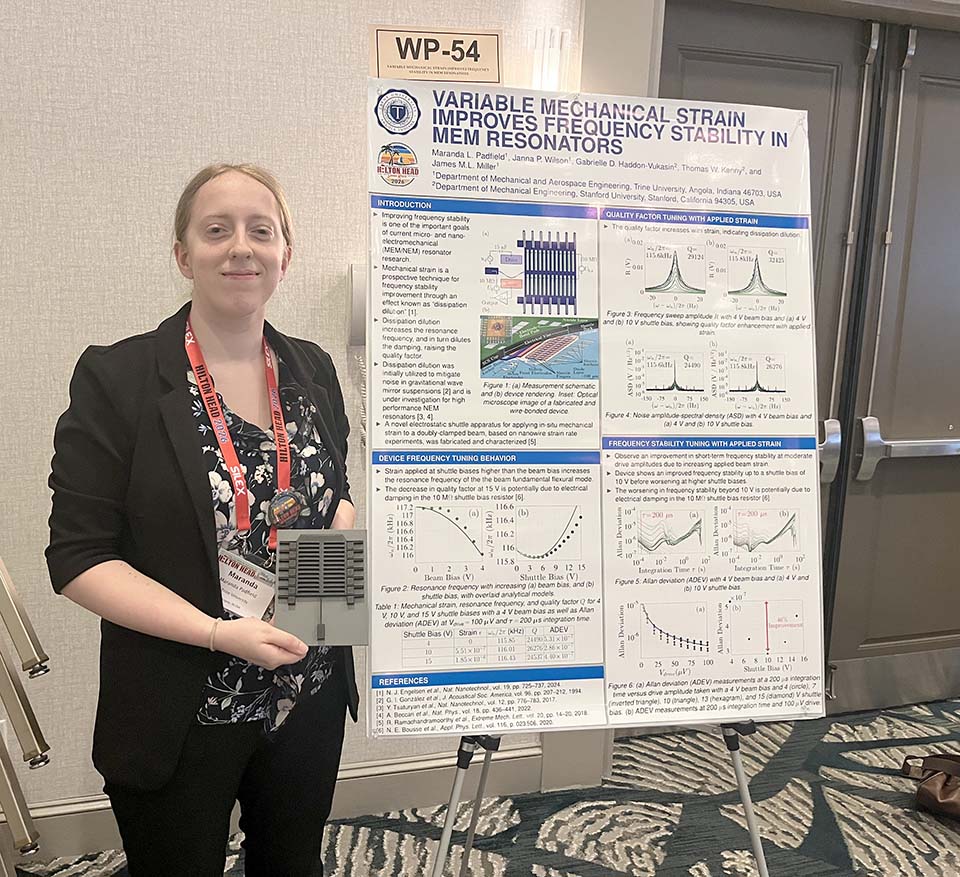
The research conducted by Maranda Padfield of Kokomo, Indiana, was titled, “Variable
mechanical strain improves frequency stability in MEM resonators."
Padfield’s research examined the effects of applied strain to a micromechanical beam
in its operating environment.
“As the tension applied to the beam increases, so does the resonance frequency of
the device, which should increase the quality factor and improve the resonance frequency
stability,” she explained.
Her research found that increased tension did have the desired effects up to a point,
yielding more than 40% improvement in frequency stability. However, this improvement
plateaued, potentially due to external electrical damping in system.
Padfield is conducting follow-up experiments this summer to better understand this
saturation effect.
“There were a couple of people in industry who were interested in the implications
for their devices,” she commented.
She said she was honored that her work was accepted into the conference, especially
as an undergraduate student, and having their entire team get accepted made it even
better.
“I am incredibly grateful that Dr. Miller took on the challenge of teaching and mentoring
us and giving us the opportunity to have published research at this stage in our education,”
she said.
She plans to eventually earn a Ph.D. and said the experience of conducting and presenting
research will help her both with graduate school and her eventual career.
“We were able to connect with many incredible professors from different universities
across the country. Being able to meet and interact with them before applying to their
labs helps make that decision a little bit easier, and them having a face to put to
a name will hopefully help my acceptance chances,” she said.
“I also got to talk to some industry leaders that were interested in my work. That
helps my internship chances during my educational career, as well as my career past
the end of my education.”
Mitigating converted frequency noise
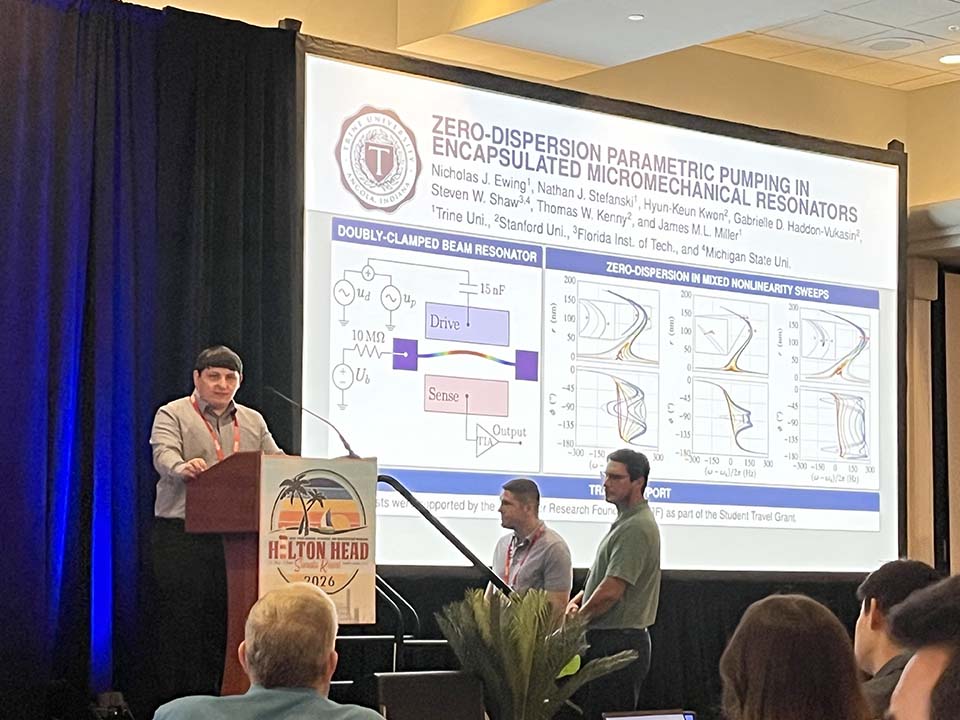
Nicholas Ewing of Wabash, Indiana, presented “Zero-dispersion parametric pumping in
encapsulated micromechanical resonators.”
His research covered two concepts in the MEMS field: zero-dispersion points, specific
points where amplitude noise in the team’s resonator does not result in frequency
noise, which can improve stability; and parametric pumping, a method of actuation
where the team modulates the spring constant of their resonator at double the frequency
of the primary driving force in order to tune the dynamics of the response, also shown
to provide improved frequency stability.
“We investigated the combination of these two concepts in a micromechanical resonator
with the goal to study if the two methods could, together, provide improved frequency
stability for application in commercial timing devices,” he said.
By applying parametric pumping, the team observed additional zero-dispersion points
beyond what is typically seen with direct-drive only.
“We believe that these points may provide additional frequency stability improvements
beyond the typically observed points,” Ewing said.
The team plans to expand upon these findings throughout this summer to determine the
impact on frequency stability.
Ewing said he had many in-depth discussions with people who stopped by his poster.
He is looking to attend graduate school and said his research work is a big step toward
that goal, since he will have two published conference papers and two journal papers
under review by the time he will apply.
New behaviors
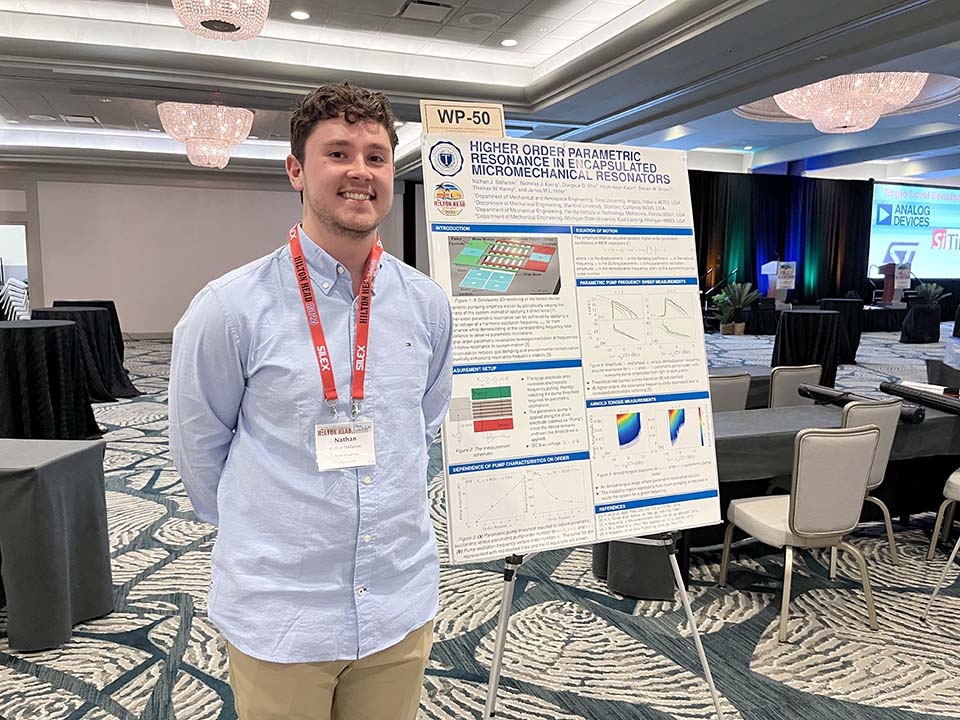
Nathan Stefanski of Almont, Michigan, researched “Higher order parametric resonance
in encapsulated micromechanical resonators.”
By exciting a device designed by Dr. Miller and fabricated by fellow researchers at
Stanford University at frequencies well below its normal operating level via higher-level
parametric pumping, Stefanski was able to observe and characterize previously unexplored
responses for devices fabricated using the same manufacturing process as commercial
timekeeping devices.
“Understanding these behaviors may help researchers and industry professionals develop
more stable and sensitive MEMS devices for future timing and sensing applications,”
he said.
“In the days leading up to the conference, I was nervous about presenting my work,”
he admitted. “However, the students, professors and industry professionals at the
conference were supportive and offered valuable advice. During the poster session,
I had constructive discussions with professors from major research universities as
well as representatives from industry. Their feedback provided new perspectives on
my work and will help guide my research efforts throughout the summer.”
He said attending the conference opened his eyes to the significant role MEMS devices
play in everyday life.
“While my own research has been primarily theoretical, many conference presentations
highlighted practical applications in defense, biomedicine, agriculture and acoustics,”
he said.