‘Something that truly helps people’: Trine team develops customized walker
May 12, 2026
Share
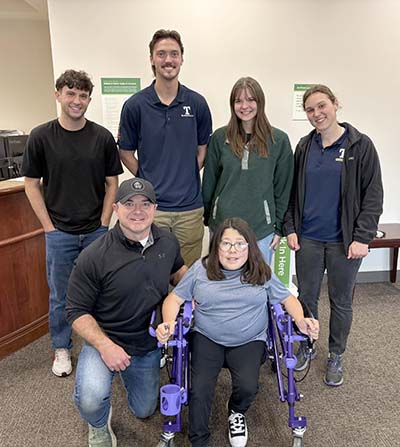
Back, from left, Trine University biomedical engineering students Liam Millership,
Colin Shriver, Hannah Knost and Elizabeth Larson designed a custom pediatric walker
for Sophia Dillon, pictured in the foreground with her father, Rob.
Liam Millership said his senior design project reminded him that “good engineering
is not just about designing something functional — it’s about designing something
that truly helps people.”
The Trine University biomedical engineering major was part of a team that developed
a custom pediatric walker for Sophia Dillon, who cannot use common gait trainers or
walkers due to multiple medical conditions.
“It's better than we expected. Sophia loves it,” said her father, Rob. “It is much
more comfortable than her old walker.”
Seeking more freedom
Sophia has a unique chromosome deletion that affects her muscle tone and strength.
In addition, she has scoliosis and kyphosis of the spine.
Though she has normal cognitive skills, she is short in stature and has limited mobility.
“We were looking for a piece of equipment that would give her more freedom,” he said.
Sophia’s physical therapist, Jithmie Jayawickrema, graduated from Trine’s Doctor of
Physical Therapy program. She put the family in contact with the university’s Allen
School of Engineering and Computing.
“We knew Sophia would enjoy the journey and could give them beneficial feedback,”
Rob said. “I was hopeful they could learn to work directly with a ‘customer’ that
wasn't a big corporation that may or may not use their design skills. This was a direct-to-consumer
situation that would immediately be life-changing for a child.”
In addition to Millership, who hails from Portage, Michigan, the senior design team
included biomedical engineering majors Elizabeth Larson of Leominster, Massachusetts,
Hannah Knost of Anderson, Indiana, and team leader Colin Shriver of Douglas, Michigan.
Like Millership, team members were drawn to the project by the opportunity to improve
Sophia’s quality of life.
“Knowing that our work could directly improve someone’s daily life made the project
especially meaningful and rewarding,” said Shriver.
Multiple designs, prototypes
The family met with the team early in the fall semester to discuss Sophia’s physical
limitations and current equipment limitations, the budget and project length and goals
for the final product.
The team also interviewed Jayawickrema and researched existing pediatric mobility
devices.
They developed and evaluated multiple design concepts using CAD modeling, 3D printing
and finite element analysis (FEA). They then built prototypes for Sophia to test.
“We explored adding a booster seat and ultimately redesigned the armrests, transitioning
from adjustable components to a lower-profile, outward-mounted design,” said Larson.
“One of the key challenges we encountered was that the patient was not comfortable
and felt as if she was falling forward using the original base frame we had selected.
This required us to revisit and modify our design to better suit her needs.”
Another big challenge was balancing stability with maneuverability.
“We overcame that through repeated prototyping and testing, including redesigning
the seat profile, changing wheel sizes and creating custom adjustable armrests and
brake mounts,” Millership said.
“This project pulled from almost every area of biomedical engineering we’ve studied
at Trine,” he said. “We applied CAD design, biomechanics, materials engineering, manufacturing
processes, engineering analysis and technical communication throughout the project.
Beyond technical skills, Trine really prepared us to work through open-ended engineering
problems and to communicate effectively as a team.”
Her favorite color
The final design provided improved comfort, stability and mobility for Sophia. Jayawickrema
also noted that it encouraged a more upright posture and provided better support compared
to her previous walker.
Once the team had a design that met all the functional requirements, they added touches
that personalized the walker for Sophia. The final product included a phone holder
and cup holder and was purple, her favorite color.
“These additions made the final product both functional and meaningful for the patient,”
Larson said.
“I’m very proud of the final product and what our team accomplished,” said Shriver.
“It was rewarding to see our design go from an idea to a fully functional device that
meets the patient’s needs and can make a real difference in her daily life.”
Rob Dillon said working with the Trine students was a “great experience.”
“It was refreshing to find such professional and knowledgeable young adults,” he said.
“From communication and prototypes to research, design and delivery, everything went
perfectly.”
The Accreditation Council for Occupational Therapy Education (ACOTE) granted Preaccreditation Status to Trine University’s Doctor of Occupational Therapy (OTD) program at its August meeting.
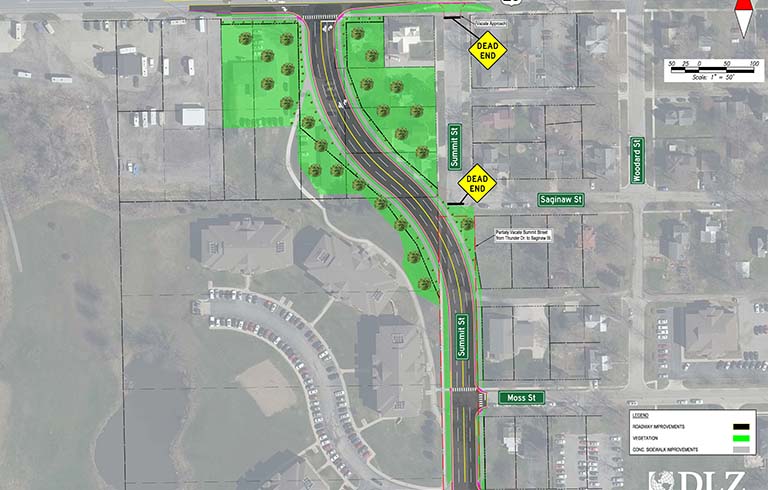
Thunder athletic fans and others who have endured traffic jams and poor visibility while trying to enter or exit Trine University on Summit Street will soon have a better route to the university’s west campus.
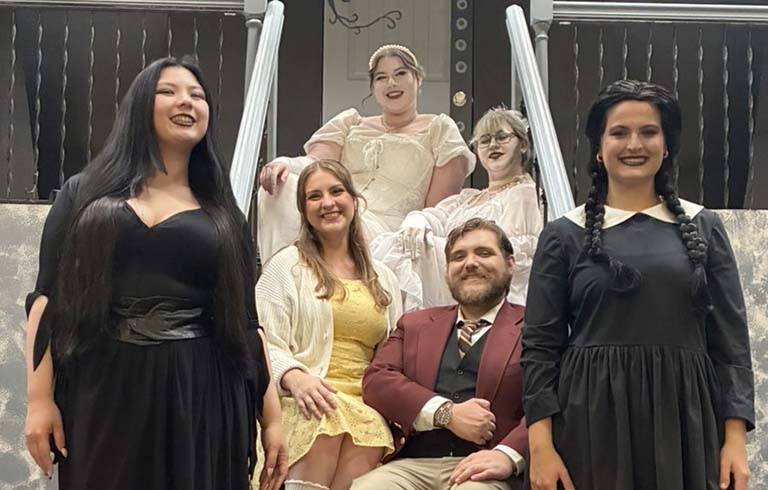
Lurch wasn’t sporting a Thunder jersey and there wasn’t a white tiger in the set decor, but the recent Gaslight Playhouse production of “The Addams Family” still had a strong Trine University presence throughout.